
Reviewed · BIKE TOURS
Best of Munich Electric Bike Tour
Munich’s story comes into focus quickly from an electric-bike saddle. In about four hours, you roll from grand neoclassical squares and royal gardens to the English Garden, river surfers, a famous beer garden, and the city’s central food market. Guides such as Canaan, Susanna, Rob, Karl, Mark, and Dan are praised for turning buildings into memorable stories rather than simple photo stops.
I especially like the well-planned route, which takes you farther than a walking tour without asking you to spend half the day on a bus. I also like the 40-minute break at the Chinese Tower beer garden, where you can order a traditional Bavarian beer and food at your own cost. The main caution is group size: with as many as 20 riders, one guide may have a lot to manage on city streets.
In This Review
- Key points to know before booking
- Why an electric bike works well in Munich
- From Wittelsbacherbrunnen to Karolinenplatz
- Königsplatz and Munich’s museum quarter
- Facing Munich’s Nazi-era past
- Royal Munich at the Residenz and Hofgarten
- Riding through the English Garden
- Eisbachwelle, Friedensengel, and the Isar
- The Deutsches Museum, Viktualienmarkt, and Jewish Munich
- Price, guide quality, and group size
- Weather, fitness, and who should book
- Cancellation and practical details
- Should you book the Best of Munich Electric Bike Tour?
- FAQ
- How long does the Best of Munich Electric Bike Tour last?
- What is included in the price?
- Are food and drinks included?
- Where does the tour start and finish?
- How many people can join the tour?
- Is the tour offered in English?
- Can I cancel for a full refund?
Key points to know before booking
- A four-hour sweep of Munich: See royal Munich, the Kunstareal museum quarter, Nazi-era landmarks, the English Garden, the Isar, and the old town in one outing.
- Electric assistance keeps the ride easy: Munich is fairly flat, but the motor helps if you want to conserve energy or the weather is poor.
- The beer-garden stop is built into the route: You get about 40 minutes at Biergarten am Chinesischen Turm, with food and drinks paid separately.
- History is the tour’s strongest thread: Guides explain the Wittelsbach monarchy, Bavaria’s military monuments, the Nazi period, postwar memorials, and Jewish life in Munich.
- The pace is active but not frantic: Stops are brief, often five minutes, with longer pauses at Odeonsplatz, the beer garden, and Eisbachwelle.
- A maximum of 20 people matters: Smaller groups allow more questions and closer attention, while larger groups require careful riding and listening.
Why an electric bike works well in Munich
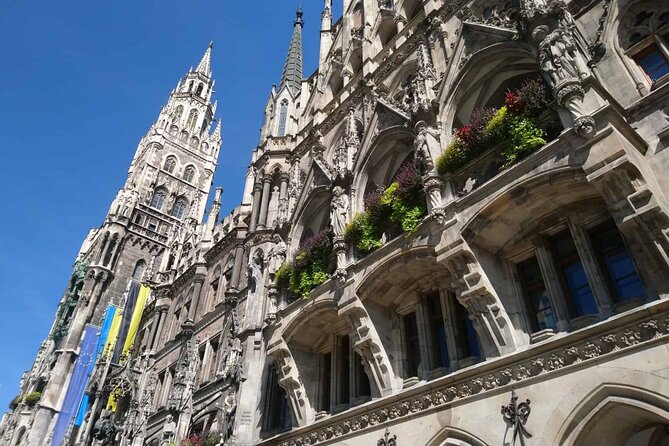
Munich’s center is compact and mostly flat, so you do not need an electric bike simply to survive the route. Several riders found the motor unnecessary because the group stops often and the city has little serious climbing. Still, I see the value in having one.
The electric assist lets you keep up without arriving sweaty or tired. It is useful in cold rain, when extra effort feels less pleasant, and for anyone who wants to save energy for museums, markets, or an evening in a beer hall. The tour can include both regular bicycles and e-bikes, and one review described the e-bike as an upgrade, so confirm exactly what your booking includes.
The ride uses pathways, streets, and sidewalks, according to the tour description and rider accounts. You need reasonable bike control and attention around traffic. One otherwise positive assessment found the group too large for a single guide to oversee comfortably on city roads, so I would choose a smaller departure if that option is available.
More bike tours in Munich:
- Munich 3-Hour Guided Bike Tour
★ 4.5 · 1,731 reviews - Classic Mike’s Bike Tour daily @ 11.30 incl Beer Garden & Surfers
★ 5.0 · 1,246 reviews - Neuschwanstein Castle by Bus Incl. Bike Ride or Hohenschwangau
★ 5.0 · 607 reviews
From Wittelsbacherbrunnen to Karolinenplatz
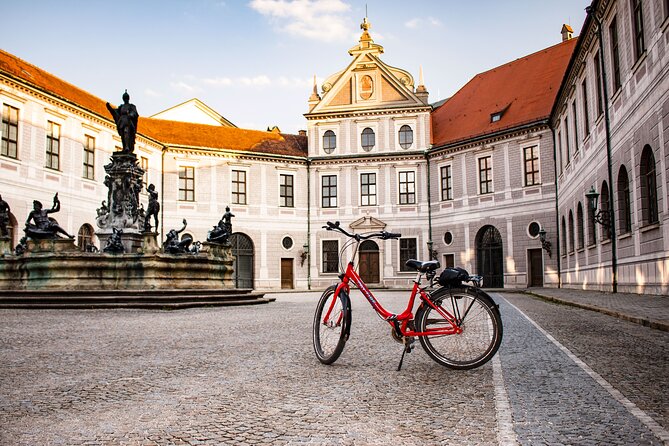
The starting point is Karlsplatz 4, a practical central location near public transportation. The route begins with the Wittelsbacherbrunnen, a grand Neo-Classicist fountain on the edge of the city center between Lenbachplatz and Maximiliansplatz.
The fountain was built from 1893 to 1895 by sculptor Adolf von Hildebrand. Its subject is the primal force of water, a fitting opening for a ride that later follows the Isar and visits Munich’s famous river wave. This is a quick look, not a full architectural stop, but it gives you an early sense of Munich’s taste for monumental public art.
At Karolinenplatz, your guide can explain how Munich’s urban design changed in the early 19th century. It was the city’s first square built around the radiating Strahlenplatz plan, with avenues spreading outward like rays. The name honors Queen Caroline of Bavaria, and the square also points to Bavaria’s close relationship with France during that period.
Expect roughly five minutes here. That sounds brief, but short stops keep the route moving. You get the basic story and a chance to look around without using up the time needed for the English Garden and beer garden later.
Königsplatz and Munich’s museum quarter
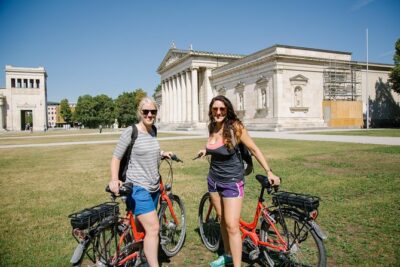
Königsplatz is one of Munich’s most theatrical public spaces. Built in a European Neoclassical style, it frames the Propyläen Gate, the Glyptothek, and the Staatliche Antikensammlungen. It also sits within the Kunstareal, Munich’s museum quarter.
The tour does not include museum admission or a long indoor visit. Instead, you get a quick orientation to the buildings and the chance to decide what deserves a return visit. That is one of the route’s practical strengths: it gives you a broad map of Munich’s cultural sights without pretending that five minutes is enough to see a major museum.
The Alte Pinakothek is another brief exterior stop. It is one of the world’s oldest galleries and holds important Old Master paintings. Nearby, the Pinakothek der Moderne brings modern and contemporary art, works on paper, design, applied arts, and architecture together under one roof.
I would not book this tour expecting serious museum time. I would book it if you want help choosing which museum to visit later. The guide’s suggestions about museums, restaurants, and other activities can be especially useful early in a Munich stay.
Facing Munich’s Nazi-era past
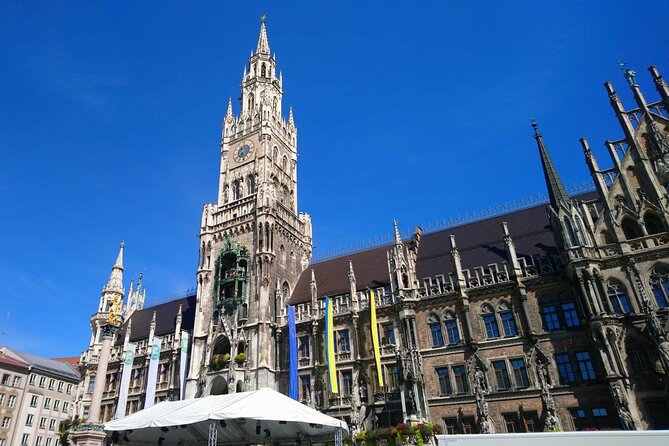
The Führerbau is a sobering stop on Arcisstrasse. Built between 1933 and 1937, it was used extensively by Adolf Hitler and remains one of the few major buildings associated with the Nazi period still standing. Today it houses the University of Music and Performing Arts Munich.
A brief exterior explanation cannot cover this period in full, but it places the building within the city’s wider story. Munich was central to the Nazi movement, and the tour does not skip that difficult chapter in favor of palaces and beer gardens. I appreciate that balance.
The route then reaches Siegestor, a three-arched monument topped by Bavaria with a lion quadriga. It was originally dedicated to the glory of the Bavarian army. After restoration following World War II, it became a reminder of peace. That change in meaning gives the monument more weight than its handsome facade suggests.
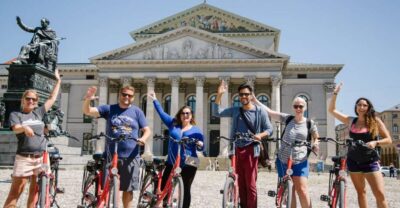
At Odeonsplatz, you get about ten minutes, one of the longer history stops. The square was laid out in the early 19th century by Leo von Klenze and forms the southern end of Ludwigstrasse. It is also tied to the 1923 Beer Hall Putsch, when a fatal gun battle ended the march at the Feldherrnhalle.
This is the point where a good guide matters most. Canaan, Rob, Karl, Susanna, and Dan have all been praised for explaining Munich’s past in a clear, engaging way. A guide who can connect the architecture, the political events, and the city’s later memory makes this more than a sightseeing circuit.
Something different, still within reach of Munich:
- From Munich: Neuschwanstein & Linderhof Castle Full-Day Trip
★ 4.5 · 12,494 reviews - Neuschwanstein & Linderhof Castle-Fairytale Day Tour from Munich
★ 4.5 · 7,275 reviews - Munich: Third Reich & WWII Walking Tour
★ 4.6 · 6,181 reviews - Dachau Concentration Camp Memorial Site Tour from Munich by Train
★ 4.5 · 5,637 reviews
Royal Munich at the Residenz and Hofgarten
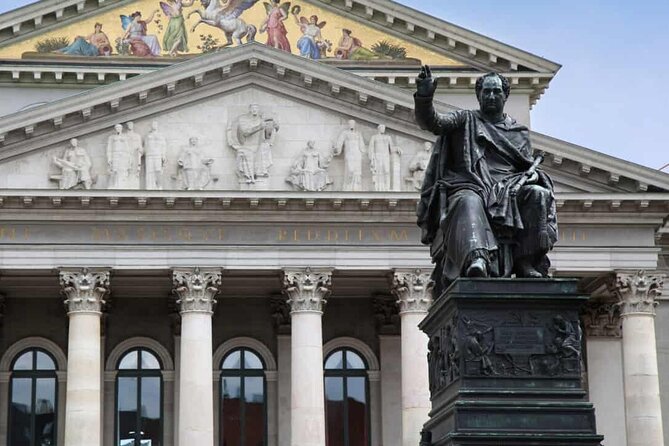
The Residenz was the city palace of Bavaria’s Wittelsbach rulers. It is Germany’s largest city palace and is now open for its rooms, decoration, architecture, and former royal collections.
You stop for about five minutes, so plan to return on your own if you want to see the interior. The quick visit is still worthwhile because it anchors Munich’s royal identity. After seeing the palace from the outside, the ornate rooms and collections make more sense if you later choose to enter.
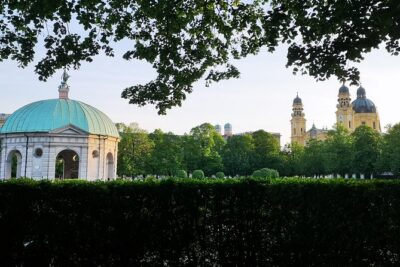
Next comes the Hofgarten, a formal garden built from 1613 to 1617 by Maximilian I, Elector of Bavaria. Its Italian Renaissance design centers on a pavilion dedicated to Diana. This is a pleasant place to pause, and the open garden provides a welcome change after the stone-heavy squares and institutional buildings.
The Bayerische Staatskanzlei follows. The building was created from 1989 to 1993 around the central dome of the former Bavarian Army Museum. The older museum had been built in 1905 and was destroyed during World War II. The result is a striking example of Munich combining surviving historic elements with modern construction.
Riding through the English Garden
The Englischer Garten is the tour’s biggest change of pace. Covering about 370 hectares, it is one of the world’s largest urban public parks. Its informal English-style design feels far removed from the rigid geometry of Königsplatz and the ceremonial buildings around Odeonsplatz.
You get about ten minutes in the park before reaching the Chinese Tower beer garden. That may sound short for such a large park, but the bicycle makes the visit practical. You can cover more ground and get a clearer sense of how the park fits into the city.
The beer garden has operated since 1974 and seats about 7,000 people. It serves Hofbräu beer and is one of Munich’s best-known beer-garden stops. The 40-minute break is not included as a food or drink package, so budget separately for your beer, meal, or snack.
I like this pause because it gives the tour a social center. You can sit at shared tables beneath the trees, try a traditional Bavarian beer, and take a proper break from the saddle. It also keeps the outing from becoming a four-hour stream of monuments.
The stop can be touristy, especially because the Chinese Tower is famous, but it still introduces you to a real Bavarian custom. If you do not drink beer, the food and the setting still make the pause useful. The tour does not include any meal, so you remain free to order as much or as little as you want.
Eisbachwelle, Friedensengel, and the Isar
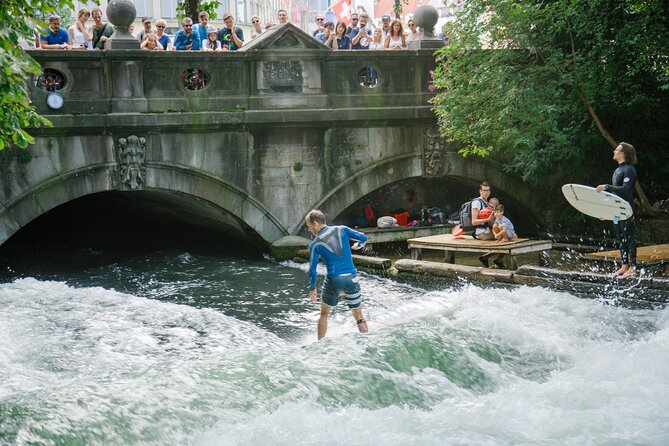
Near the Haus der Kunst, the Eisbach forms a standing wave about one meter high. Experienced surfers ride it even though the water is cold and shallow, sometimes only 40 centimeters deep. You stop for about ten minutes to watch this unusual Munich scene.
The wave is one of those city sights that is easy to miss if you follow only the standard old-town route. It also shows how Munich’s relationship with water is not limited to fountains and riverbanks. The ride begins with the symbolic power of water at Wittelsbacherbrunnen and later brings you to a living, athletic version of the same theme.
The Friedensengel, or Angel of Peace, rises above Maximilian Park near the Isar. A 38-meter Corinthian column supports a six-meter statue modeled on the Nike of Paeonius. Below it is a fountain with a dolphin waterspout and four smaller waterspouts, plus stairways to the observation deck.
You get about five minutes here, enough for photographs and a short explanation. The monument’s position at the eastern end of the sightline along Prinzregentenstrasse also gives your guide a chance to explain how Munich uses long avenues and formal viewpoints.
The Maximilianeum is another quick exterior stop. Built as a foundation for gifted students, it has housed the Bavarian State Parliament since 1949. Its grand appearance fits the royal and civic tone of the route, while its present use connects the city’s older architecture with modern Bavarian government.
The Deutsches Museum, Viktualienmarkt, and Jewish Munich
The Deutsches Museum is the world’s largest museum of science and technology, with about 125,000 objects from 50 fields. The bike tour only gives you an outside orientation, but that is enough to flag a museum that can easily fill several hours on another day.
The Viktualienmarkt brings the route back to everyday Munich. What began as a farmers’ market now has about 140 stalls and shops selling flowers, exotic fruit, game, poultry, spices, cheese, fish, and juices. You get roughly five minutes, so think of this as a preview rather than a shopping stop.
I would note the market for a later visit, especially if you want to assemble a casual lunch or browse local food without committing to a formal restaurant. Since the beer-garden break is also flexible and self-paid, the tour gives you two useful food pointers without forcing either purchase.
The final stop is Ohel Jakob Synagogue at Sankt-Jakobs-Platz. Built between 2004 and 2006 as the main synagogue for Munich’s Jewish community, it was inaugurated on November 9, 2006, the 68th anniversary of Kristallnacht.
This is an important closing note. The route has covered royal power, military memory, Nazi persecution, postwar peace, science, food, and Jewish life. At Ohel Jakob, the city’s past and present meet in a working place of worship and community. The stop lasts about five minutes, but its significance is much larger than the clock suggests.
The tour then returns to Karlsplatz 4. Exact riding time depends on the group and traffic, but the full activity lasts about four hours.
Price, guide quality, and group size
At $71.90 per person, I consider this a fair price if you want a guided overview rather than a simple bicycle rental. The electric bike and helmet are included in the stated tour details, and the route covers enough ground to make the motor useful for convenience even if it is not essential for hills.
The value comes mainly from the guide. Canaan is praised for combining historical detail with humor and for watching group safety closely. Susanna is described as warm, informative, and good at keeping the timing on track. Rob receives strong praise for his recommendations and explanations, while Karl is noted for answering questions and making the tour feel personal. Mark and Dan are also singled out for clear commentary and useful local suggestions.
Those names do not guarantee who will lead your departure, but they show the type of guide Fat Tire Tours can provide. The experience is best when the guide explains why a place matters, not simply what it is called.
The maximum group size is 20. That is manageable for a well-organized ride, but it is not intimate. One rider felt the group was too large for one guide on busy roads, while smaller groups allowed the guide to adjust the experience more closely. If you value frequent questions or extra individual attention, ask about group size before booking.
Weather, fitness, and who should book
Several riders enjoyed the outing in rain or cold, but poor weather naturally makes bike riding less comfortable. The e-bike helps with effort, not with wet clothing or chilly hands, so check the forecast and dress accordingly.
The route is described as flat and suitable for all riding levels, but it is not a passive sightseeing ride. You will pedal, steer, stop, start, and remain alert around other bikes and city traffic. One account also described the outing as involving a fair amount of walking, so anyone with limited mobility should consider that before booking.
I think this tour suits first-time visitors who want a fast orientation, history fans who like connecting places to events, families with teenagers, and anyone deciding which museums or neighborhoods deserve more time. It also works well near the start of a Munich stay, since the guides often offer restaurant, museum, and activity suggestions.
You may prefer a walking tour if you want to linger at each sight, enter museums, or avoid cycling in a larger group. You may also prefer a dedicated food tour if the beer-garden stop is your main interest. This ride is about range and context, not long visits inside individual attractions.
Cancellation and practical details
You receive confirmation when booking, and the activity starts and ends at Karlsplatz 4 in Munich. It is offered in English, uses a mobile ticket, and is near public transportation.
Free cancellation is available up to 24 hours before the local start time for a full refund. Changes or cancellations within 24 hours are not accepted for a refund. The tour requires a minimum number of participants, so if the operator cancels for that reason, you are offered another date or experience, or a full refund.
Should you book the Best of Munich Electric Bike Tour?
I would book it if you want to cover a lot of Munich in one morning or afternoon and prefer stories over a list of picture stops. The route gives you royal squares, museums, Nazi-era sites, gardens, river culture, food, and Jewish Munich in a sensible order.
The strongest reason to choose it is the guide. Canaan, Susanna, Rob, Karl, Mark, and Dan are all praised for clear explanations, safety awareness, humor, and local recommendations. The main reasons to hesitate are the possible 20-person group, the short time at most sights, and the extra cost of food and drinks.
For a first look at Munich, the price is reasonable and the e-bike makes the city easy to reach. If you want a relaxed ride with serious historical content and a well-timed beer-garden break, this is a good choice.
FAQ
How long does the Best of Munich Electric Bike Tour last?
The tour lasts approximately four hours and returns to the starting point at Karlsplatz 4.
What is included in the price?
The stated inclusions are a live English-speaking guide, an electric bike, and a helmet.
Are food and drinks included?
No. Food and drinks are not included. The route includes about 40 minutes at Biergarten am Chinesischen Turm, where you pay for anything you order.
Where does the tour start and finish?
It starts at Karlsplatz 4, 80335 München, Germany, and ends back at the same meeting point.
How many people can join the tour?
The maximum group size is 20 participants.
Is the tour offered in English?
Yes. The activity is offered in English and uses a mobile ticket.
Can I cancel for a full refund?
Yes. You can cancel at least 24 hours before the local start time for a full refund. Cancellations or changes made less than 24 hours before the start time are not refunded or accepted.
Just added around Munich
- Private Transfer from Munich to Salzburg, English-speaking driver★ 3.5 · 3 reviews
- Private tour from Munich to Rothenburg and Harburg★ 5.0 · 3 reviews
- Scenic Adventure Private Day Tour to The Konigssee Salzburg★ 4.5 · 3 reviews
- Munich: Capture the most Photogenic Spots with a Local★ 5.0 · 3 reviews
- Private Beer Tasting Tour in Munich with Oktoberfest Museum★ 4.3 · 3 reviews
- Munich Photoshoot: A Must-Have Holiday Experience!★ 5.0 · 3 reviews
- Private Tour to Hallstatt Salt Mine and Skywalk with Lunch★ 5.0 · 3 reviews
- Paul’s Private Tour in the Alte Pinakothek Munich★ 5.0 · 3 reviews
Bike Tours, compared.
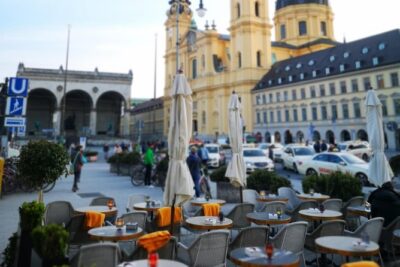
Classic Mike’s Bike Tour daily @ 11.30 incl Beer Garden & Surfers
Read our review →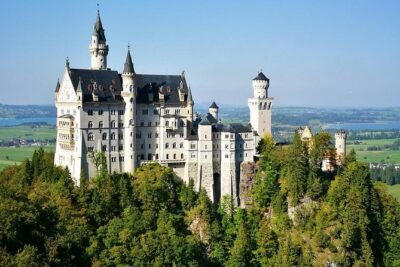
Neuschwanstein Castle by Bus Incl. Bike Ride or Hohenschwangau
Read our review →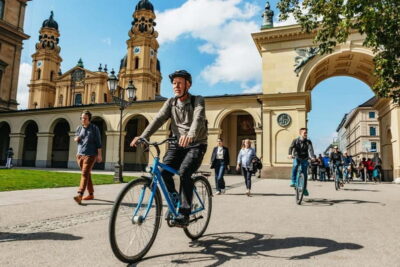
Classic Guided City Tour by Bike (English Tour Only)
Read our review →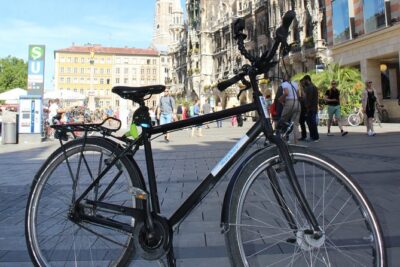
Mini Classic Bike Tour @ 4pm incl. Beer Garden & Surfers 2,5 hrs
Read our review →Browse the lists this tour appears in