
Reviewed · THIRD REICH & WWII TOURS
Private Tour: Munich Third Reich Walking Tour
Munich was the city where Hitler built his political career, and this private walk takes you to the places where that story began. You’ll connect major events to real streets, squares, and buildings, including the site of the failed Beer Hall Putsch and the place where Hitler first joined the Nazi Party.
I like the private format, which lets your guide adjust the pace and answer questions without a large group slowing things down. I also like the use of old photographs, a practical touch that helps you picture buildings and streets that have changed.
The main drawback is the price: $240.28 per person is a serious cost for a two-hour walk, especially for one or two people. The experience makes more financial sense for a small group sharing the private booking, and you should be ready for a fair amount of walking.
In This Review
- Key points to know before you book
- Why Munich is the right place for this difficult history
- Starting at Radius Tours or your central hotel
- Marienplatz, Munich’s central stage
- Following Hitler’s early political path
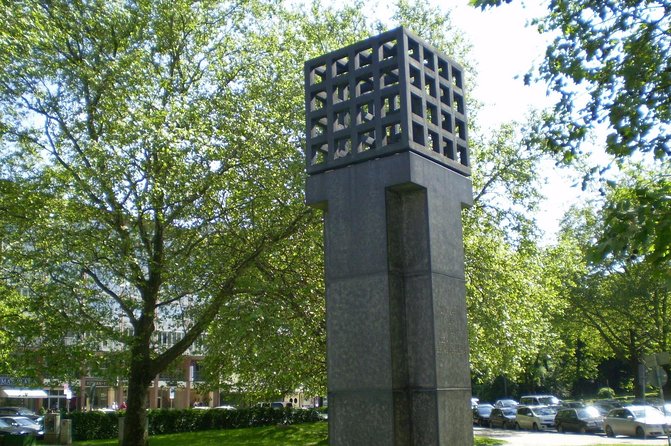
- The Beer Hall Putsch and the failed 1923 coup
- Hofbräuhaus, beer, and political history
- What the private guide adds
- Walking pace, families, and practical comfort
- Is $240.28 per person a fair price?
- Booking, cancellation, and who should choose it
- FAQ
- How long does the Munich Third Reich walking tour last?
- Where does the tour begin?
- Is hotel pickup included?
- Is the tour private?
- What language is the tour offered in?
- What is included in the price?
Key points to know before you book
- Munich’s Nazi-era story begins here: See sites tied to Hitler’s rise, the early Nazi Party, the Gestapo, and the 1923 Beer Hall Putsch.
- Your guide can shape the walk: Guides such as Mark, Sarah, and Steve have adapted explanations for slower walkers, families, and visitors arriving later than planned.
- Hotel pickup is available: You can begin at a central Munich hotel, or meet at Radius Tours on Dachauer Straße.
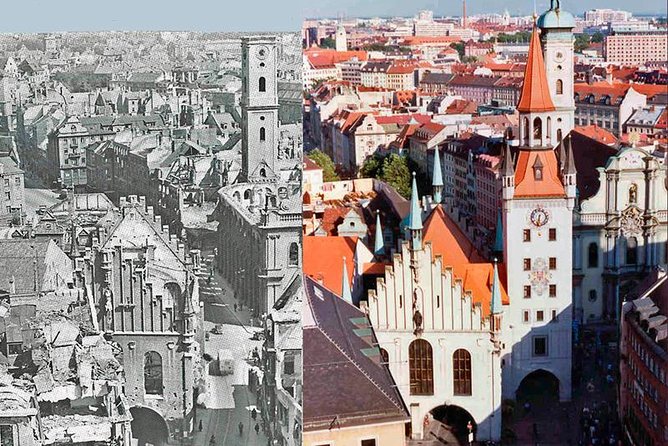
- Old photographs add useful context: Since many buildings no longer look as they did, visual comparisons help fill in the gaps.
- The walk ends with Hofbräuhaus: You stop at Munich’s famous beer hall, though food and drinks cost extra.
- Two hours goes quickly: This is a focused introduction, not a full study of Nazi Germany or Munich’s museums.
Why Munich is the right place for this difficult history
Munich was not just another city in the story of Nazi Germany. It was where Adolf Hitler first built a political base, where Nazi policies took shape, and where the movement attempted to seize power in 1923.
That makes the city especially useful for understanding cause and place. You are not simply hearing a list of dates in a classroom. You are walking through central Munich and seeing how political speeches, party meetings, failed coups, and government offices fit into the city you visit today.
The subject is grim, and a good guide needs to keep the facts clear without turning the tour into a dramatic show. This experience is strongest when it explains how power was built, how propaganda worked, and how ordinary urban spaces became tied to crimes and political violence.
I would not book this walk expecting a museum visit or a formal memorial program. It is an outdoor history lesson, built around streets and landmarks. Some original buildings have changed or disappeared, so the guide’s explanations and photographs matter as much as the places themselves.
More Third Reich and wartime history walks in Munich:
- Munich: Third Reich & WWII Walking Tour
★ 4.6 · 6,181 reviews - Third Reich Walking Tour Munich
★ 4.5 · 4,291 reviews - Munich: Birthplace of the Third Reich Guided Walking Tour
★ 4.6 · 771 reviews
Starting at Radius Tours or your central hotel
The usual meeting point is the Radius Tours office at Dachauer Straße 4, near central Munich. If you provide your hotel details in advance, pickup and return to a central Munich accommodation are included.
That is useful if you are still finding your way around the city. One especially practical touch is that a guide can help you orient yourself at the end of the walk. Sarah, for example, helped one family understand the subway and sent them in the right direction after the tour.
The pickup arrangement is worth confirming carefully when you book. If no hotel information is passed along, you are expected to meet at the tour office. The listed end point is the same as the start point, although a hotel pickup generally means the guide returns you to that starting hotel.
The tour is offered in English and is private, so only your group participates. That gives you room to ask direct questions about difficult subjects. It also means you can tell the guide if your group needs a slower pace. Mark received praise for being patient with slower walkers and for handling a long list of questions.
Marienplatz, Munich’s central stage
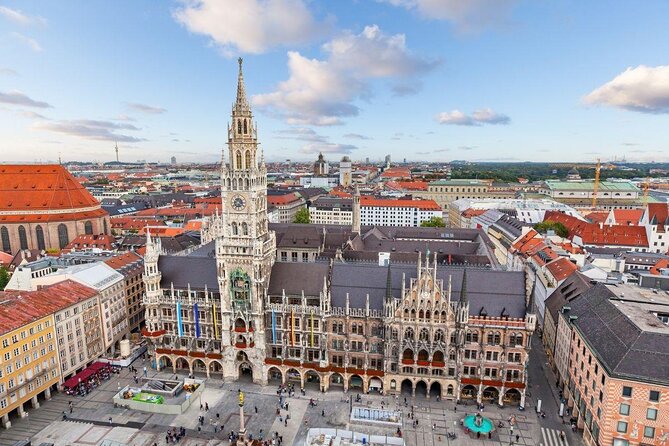
Marienplatz is listed as an early stop, with about 10 minutes set aside. It is Munich’s central square and a natural place to begin placing the Nazi era within the wider city.
You should not expect a long architectural lecture here. The value is in seeing how a familiar civic center connects to the political story the guide is explaining. The square helps you get your bearings before moving on to more specific Nazi-era locations.
Because the stop is short, ask questions while you are there. A private tour works best when you treat it as a conversation rather than waiting for a fixed speech to finish. If you have a particular interest, such as the Beer Hall Putsch, party organization, or Hitler’s early years in Munich, mention it early.
Marienplatz is also a busy public place. That can make it harder to hear every word, especially if the square is crowded. Stay close to your guide and do not assume that every important location will have a large sign explaining its role.
Following Hitler’s early political path
One of the most useful parts of the walk is the stop at the building where Hitler first joined the Nazi Party. This gives the tour a clear starting point for his political rise.
The detail matters because it moves the story away from the idea that power appeared suddenly in Berlin. Munich was an early base for the movement, and the tour shows how local political activity helped create a national threat.
The walk also covers the former Gestapo headquarters. The building’s present appearance may not tell you much on its own, which is why the guide’s narrative is important. You will need to listen closely to understand what happened there and how the Nazi state used offices, institutions, and fear to control people.
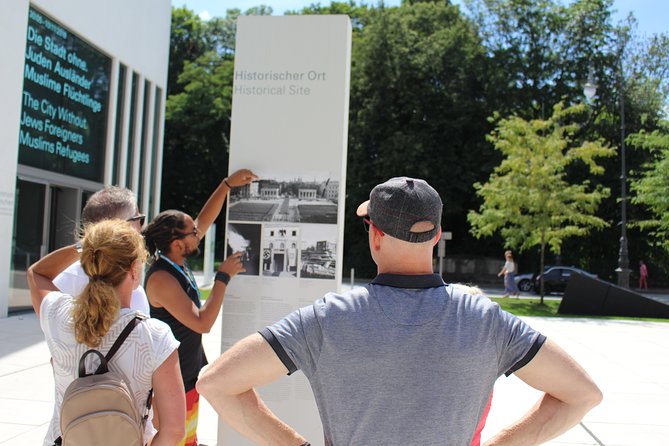
This is where the private setup earns its keep. You can stop and ask what remains of the original building, what has changed, and how the site fits into the broader history. Some guides also use old photographs to show how the area looked during the Third Reich.
Do not expect every stop to look like a preserved historical site. Munich has changed, and the physical evidence is uneven. That can be frustrating if you want intact buildings, but it also makes the guide’s interpretation essential.
More walking tours in Munich:
- Munich: Old Town & Viktualienmarkt City Walk in German
★ 4.7 · 2,304 reviews - Munich: Night Watchman Walking Tour
★ 4.7 · 2,092 reviews - Munich Ghosts and Spirits Evening Walking Tour
★ 5.0 · 1,900 reviews - Munich Old Town Walking Tour
★ 4.5 · 1,287 reviews
The Beer Hall Putsch and the failed 1923 coup
The Beer Hall Putsch, also called the Munich Putsch, is one of the central events covered on the walk. In 1923, Hitler and other Nazi leaders attempted a failed coup in Munich as they tried to seize political power.
The location gives you a concrete setting for a turning point. The coup failed, but it helped bring Hitler wider attention and became part of the political mythology the Nazis later used.
A good guide will help you separate the actual event from the way the Nazi Party later presented it. That distinction is valuable. Political movements often turn failure into a story of sacrifice and destiny, and the tour gives you a chance to see how that process began in Munich.
This stop may feel less visually dramatic than a grand palace or cathedral. That is normal. You are visiting a place because of what happened there, not because the building offers a complete display by itself.
If you want the clearest possible account, ask your guide to lay out the sequence of events in order. One past participant found a disorganized route difficult to follow, even though the guide could answer questions. That is a fair warning: private does not always mean perfectly structured. If the chronology becomes confusing, speak up and ask for a quick reset.
Hofbräuhaus, beer, and political history
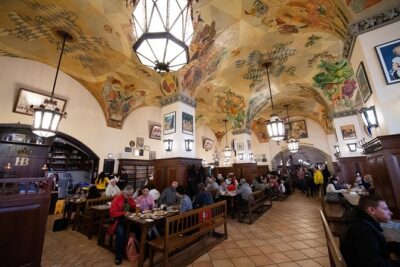
The tour includes about 20 minutes at Staatliches Hofbräuhaus, Munich’s famous beer hall. This is the most relaxed stop on the route, but it also has a political connection to Munich’s past.
The stop gives you a chance to see a place associated with Munich’s beer culture while considering how beer halls served as meeting places for political groups. It is a useful reminder that the Nazi movement did not grow only in government offices. Public meeting spaces and mass gatherings also mattered.
Food and drinks are not included, so budget extra if you want a beer or something to eat. You may prefer to treat the stop as a look around rather than a full meal, especially since the tour lasts only about two hours.
The Hofbräuhaus visit also adds variety to a serious walking route. After several difficult sites, ending in a famous Munich institution can help the tour feel connected to the city you are visiting now, not only to its darkest period.
Still, the beer hall may be busy, and 20 minutes is not enough for a leisurely meal. If you want a long lunch or a full beer-hall evening, plan that separately after the tour.
What the private guide adds
The best part of this experience is the human explanation between the locations. Guides such as Mark, Sarah, and Steve have been singled out for clear answers, flexible pacing, and the ability to adjust the tour for different groups.
Sarah adapted the discussion for children aged 9 and 13, keeping them involved without removing the serious subject matter. That makes the walk a reasonable option for families with older children who can handle Nazi-era history.
Steve was also able to adjust the schedule for a group arriving in Munich later than expected. You should not assume every timing change can be accepted, but the private format gives the guide more room to respond than a fixed group departure would.
The guide’s quality matters more here than on a simple sightseeing loop. You are paying for judgment, context, and the ability to explain what is no longer visible. If your guide uses photographs, ask to compare them with the present-day view. That is one of the clearest ways to understand how Munich has changed.
There is some variation in guiding style. One guide was described as flustered and less certain about the route, while still being able to answer many questions. I would treat that as a reason to prepare a few questions of your own, not as proof that the experience will be poor. The overall rating is 4.7 out of 5 from 31 reviews, with 90 percent of visitors recommending it, but no private tour can guarantee the same guide or the same delivery.
Walking pace, families, and practical comfort
The tour lasts about two hours and includes a substantial amount of walking through central Munich. Comfortable shoes are a sensible choice, and you should not book it immediately after a long rail journey if your group is already worn out.
Most people can take part, and service animals are allowed. The tour runs near public transportation, which helps if you need to reach the meeting point or continue elsewhere afterward.
The private format is helpful for mixed groups. A slower walker can ask for time without holding up a large party, and families can ask for explanations suited to younger listeners. At the same time, private does not mean the route is effortless. One positive account specifically noted that the tour was not easy for the guide because many locations no longer look as they once did.
I would allow extra time after the walk if you want to visit another site, eat at Hofbräuhaus, or discuss the subject with your group. The tour itself is tightly timed, especially with the 20-minute Hofbräuhaus stop.
Is $240.28 per person a fair price?
At $240.28 per person, this is not a budget walking tour. The value depends heavily on the size of your group and how much you want personal attention.
For a solo visitor, the price is difficult to justify unless this subject is a major reason for your Munich visit. For a family or group splitting the private booking, the cost becomes easier to understand. Group discounts are offered, though the exact saving is not provided here.
You are paying for more than a route between famous sights. The fee includes a private professional guide, hotel pickup and drop-off, and the chance to shape the conversation around your interests. A shared tour may cost less, but it may also give you less time for questions and less flexibility for slower walkers or children.
The short duration keeps the commitment manageable, but it also limits the number of places the guide can cover. I see this as an introduction to Munich’s Nazi-era story, not a complete account. If you want museums, extended memorial visits, or a full-day study, you will need to add other sites on your own.
Booking, cancellation, and who should choose it
You receive confirmation at booking unless you reserve within seven days of the tour. For bookings made within that period, confirmation is expected within 48 hours, subject to availability.
The cancellation terms are strict close to departure. Cancel at least six full days before the start for a full refund. Cancellation two to six full days ahead brings a 50 percent refund, while cancellation less than two full days before the start receives no refund. Changes inside those same windows are not accepted.
I would book this tour if you want a focused, personal explanation of Munich’s role in Nazi Germany and you value asking questions. It suits history-focused visitors, families with older children, and small groups that want hotel pickup and a flexible pace.
I would skip it if you mainly want grand architecture, a relaxed city stroll, or a low-cost introduction. The subject is serious, the walk can be tiring, and the per-person price is high for two hours. For the right group, though, the combination of real locations, old photographs, and a private guide can turn Munich’s difficult past into something much easier to understand.
FAQ
How long does the Munich Third Reich walking tour last?
The tour lasts approximately two hours.
Where does the tour begin?
It begins at Radius Tours, Dachauer Straße 4, 80335 Munich, unless you arrange pickup from a central Munich hotel.
Is hotel pickup included?
Yes. Hotel pickup and drop-off are included when you provide the hotel details. If no details are forwarded, you should meet the guide at the Radius Tours office.
Is the tour private?
Yes. Only your group participates in the private activity.
What language is the tour offered in?
The tour is offered in English.
What is included in the price?
The price includes the private tour, a professional guide, and hotel pickup and drop-off. Food and drinks are not included.
Just added around Munich
- Private tour from Munich to Rothenburg and Harburg★ 5.0 · 3 reviews
- Scenic Adventure Private Day Tour to The Konigssee Salzburg★ 4.5 · 3 reviews
- Private Transfer from Munich to Salzburg, English-speaking driver★ 3.5 · 3 reviews
- Munich: Capture the most Photogenic Spots with a Local★ 5.0 · 3 reviews
- Private Beer Tasting Tour in Munich with Oktoberfest Museum★ 4.3 · 3 reviews
- Munich Photoshoot: A Must-Have Holiday Experience!★ 5.0 · 3 reviews
- Paul’s Private Tour in the Alte Pinakothek Munich★ 5.0 · 3 reviews
- Private Tour to Hallstatt Salt Mine and Skywalk with Lunch★ 5.0 · 3 reviews
Third Reich & WWII Tours, compared.

Birthplace of the Third Reich Guided Walking Tour
Read our review →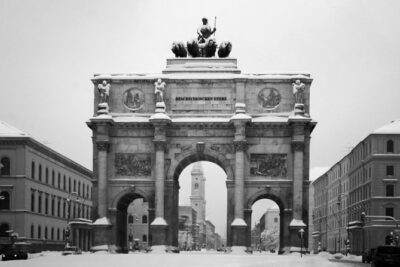
Munich World War II Sites Including Dachau Concentration Camp
Read our review →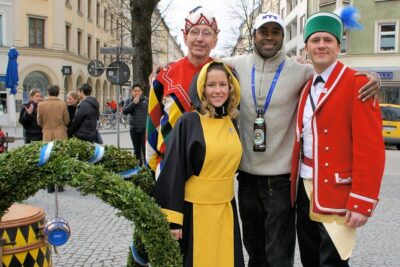
Munich City Walking Tour, includes Third Reich & Viktualienmarkt
Read our review →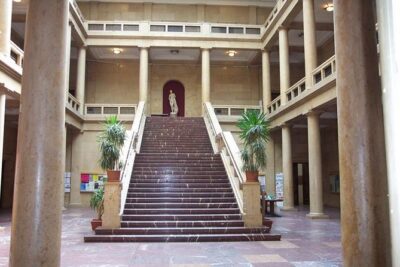
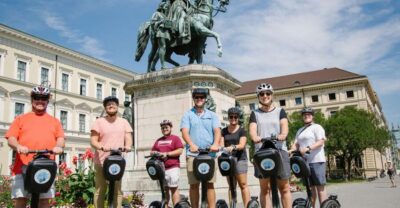
Munich 3-Hour Segway Tour: Nazi Munich & Royal Architecture
Read our review →
Dachau Concentration Camp Memorial Site And Third Reich Day Tour From Munich
Read our review →Browse the lists this tour appears in