
Reviewed · THIRD REICH & WWII TOURS
Walking Tour on Origins of Nazism in Munich – English
Munich’s grand squares and elegant avenues hide a difficult past. This two-hour walk connects the city’s Nazi origins with the places where the movement gained power, staged propaganda, attempted a coup, and left its mark on modern Germany.
I like the route’s clear historical progression and its finish at Königsplatz, where the scale of the former Nazi civic center becomes easier to understand. I also like that the walk includes memorials to resistance fighters and victims, rather than treating the subject as a parade of Nazi landmarks.
The main drawback is time. Six stops in roughly two hours leaves little room for long questions or detailed museum visits, and the subject is so broad that you may want to add a museum afterward.
In This Review
- Key points to know before you book
- Why this Munich walk matters
- Starting at the Mariensäule in Marienplatz
- The Square of the Victims of National Socialism
- Hofbräuhaus and the party’s Munich base
- Haus der Kunst and the machinery of propaganda
- Hofgarten and the question of resistance
- Odeonsplatz and the failed coup attempt
- Königsplatz and the Nazi city plan
- What you get for $20.16
- Timing, walking, and who will enjoy it
- How to get more from the guide
- Should you book this Munich history walk?
- FAQ
- How long is the Walking Tour on Origins of Nazism in Munich?
- What time does the tour start?
- Where does the tour begin?
- Where does the tour end?
- What language is the tour conducted in?
- What locations are included?
- Is lunch included?
- How many people can join the tour?
- Can I cancel for a full refund?
Key points to know before you book
- A chronological Munich walk: Follow the story from Hitler’s early political activity to the Third Reich’s city planning.
- Six central stops: The route visits the Square of the Victims of National Socialism, Hofbräuhaus, Haus der Kunst, Hofgarten, Odeonsplatz, and Königsplatz.
- English-language expert guide: The guide explains the political meaning behind places that can otherwise look like ordinary city sights.
- A useful first introduction: The walk works well if you know little about Munich’s Nazi past and want a solid framework before visiting museums.
- Two hours on foot: The tour starts at 3 p.m. near the Mariensäule in Marienplatz and ends at Königsplatz.
- Small enough to remain manageable: The maximum group size is 35 people, though this is not a private tour.
Why this Munich walk matters
Munich was not simply a backdrop to Nazi history. It was one of the movement’s main political homes, and this tour helps you see how ordinary city spaces were turned into sites of speeches, party organization, propaganda, violence, and remembrance.
That is the strongest reason to book. You are not just ticking off famous buildings. You are learning how a political movement grew inside a respected Bavarian city, then reshaped parts of that city to serve its own image.
The route also tackles several episodes that are difficult to place on your own. These include Hitler’s failed coup attempt, the burning of books associated with Goebbels, and Kristallnacht, the night of broken glass. The walk is designed to explain the meaning and consequences of Nazism, not to present it as a collection of dramatic anecdotes.
I would treat this experience as a historical orientation walk. It gives you the structure and vocabulary needed to understand later visits to museums, memorials, and documentation centers. It is less suitable if you already have a detailed knowledge of the period and want long discussions at each site.
More Third Reich and wartime history walks in Munich:
- Munich: Third Reich & WWII Walking Tour
★ 4.6 · 6,181 reviews - Third Reich Walking Tour Munich
★ 4.5 · 4,291 reviews - Munich: Birthplace of the Third Reich Guided Walking Tour
★ 4.6 · 771 reviews
Starting at the Mariensäule in Marienplatz
The meeting point is the Mariensäule at Marienplatz 22. This puts you in central Munich, close to public transportation and in one of the easiest parts of the city to reach.
The tour begins at 3 p.m. That timing can work well with a morning visit to another Munich sight, but you should leave enough time to find the exact meeting point. Marienplatz is a busy square, so arriving a little early is sensible even though the information does not specify a separate check-in procedure.
From here, the guide sets the political story in motion. The focus is on how Adolf Hitler, originally sent to Munich to observe the German Workers’ Party, became its leader and helped reshape it into the National Socialist German Workers’ Party.
That opening is important because it avoids presenting Hitler’s rise as inevitable. The story begins with political weakness, opportunity, organization, and persuasion. A good guide can show you how a city’s public spaces became useful to a movement that was still trying to build an audience.
The Square of the Victims of National Socialism
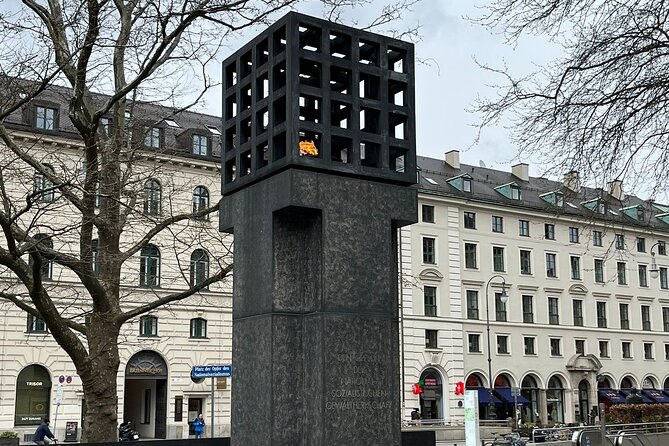
The first stop is the Platz der Opfer des Nationalsozialismus, or Square of the Victims of National Socialism. The visit lasts about 15 minutes and admission is free.
This is a fitting place to begin because it establishes the moral frame for the walk. The subject is not only the rise of a political party or the ambitions of one dictator. It is also about the people harmed by Nazi policy and the way Munich remembers them.
You can expect the guide to place the later stops in the context of persecution, war, and resistance. That matters because Nazi-era architecture and party sites can otherwise attract attention for their size or symbolism while pushing victims out of view.
A short stop here cannot cover every group targeted by the regime. Still, it gives the tour a needed balance from the start. I appreciate that the route includes memorials and resistance sites instead of focusing only on Hitler and Nazi leaders.
Hofbräuhaus and the party’s Munich base
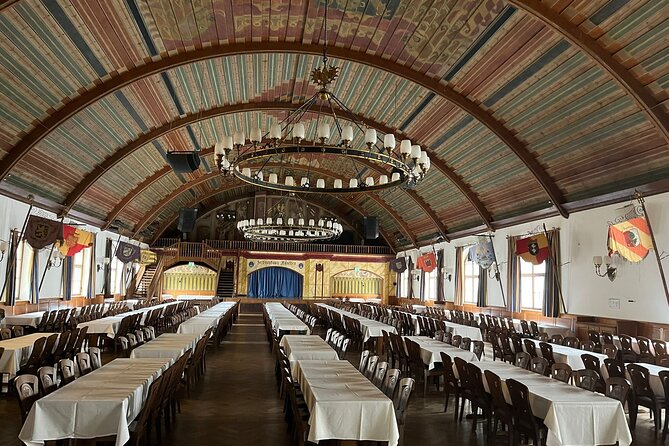
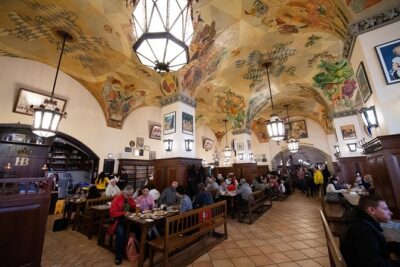
The next stop is Staatliches Hofbräuhaus, described as both Munich’s famous brewery and a place connected to the Nazi Party’s early organization. The stop lasts about 15 minutes, with admission included.
Hofbräuhaus is one of Munich’s best-known traditional sights, which makes its political connection especially useful. You see how a familiar public venue could become part of the story of party meetings and political mobilization.
The key value here is contrast. A brewery associated with Bavarian social life also appears in the history of a movement that would later control Germany. That does not mean the building itself explains Nazism. It does show how political movements use accessible, well-known public places to gather supporters and spread ideas.
Because the stop is short, do not expect a full tour of the brewery or a meal. Lunch is not included, and the experience is built around walking and explanation rather than dining. If you want to eat at Hofbräuhaus, plan that separately before or after the tour.
More walking tours in Munich:
- Munich: Old Town & Viktualienmarkt City Walk in German
★ 4.7 · 2,304 reviews - Munich: Night Watchman Walking Tour
★ 4.7 · 2,092 reviews - Munich Ghosts and Spirits Evening Walking Tour
★ 5.0 · 1,900 reviews - Munich Old Town Walking Tour
★ 4.5 · 1,287 reviews
Haus der Kunst and the machinery of propaganda
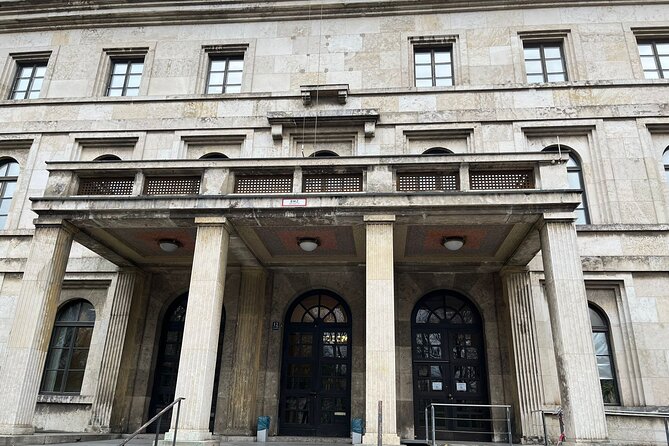
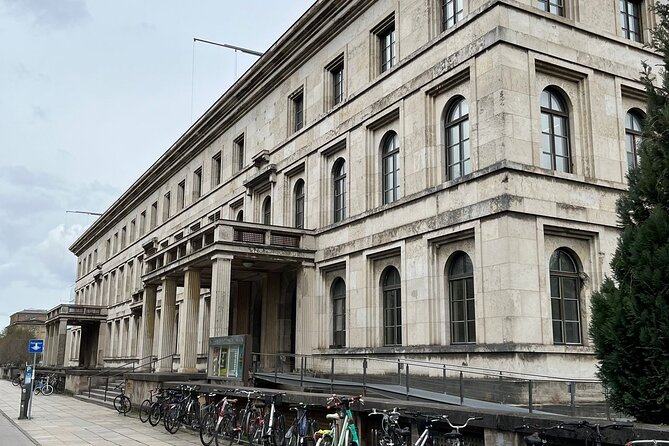
The walk continues to Haus der Kunst, a current museum described as the first propaganda building of the Third Reich. The group spends about 15 minutes here, with admission included.
This is one of the more useful stops for understanding how the Nazi government tried to shape public taste and political opinion. The building was not only about art. It was part of a larger effort to present the regime as the guardian of German culture.
The guide can help you read the building as propaganda rather than admire it only as architecture. That distinction is valuable. Authoritarian governments often use monumental design, cultural institutions, and grand public events to make political power look permanent and respectable.
The stop also connects with the book burnings associated with Goebbels. A two-hour walk cannot examine every detail of Nazi cultural policy, but this part of the route should help you see that propaganda reached beyond speeches and posters. It also involved books, art, buildings, public ceremonies, and control of acceptable ideas.
Hofgarten and the question of resistance
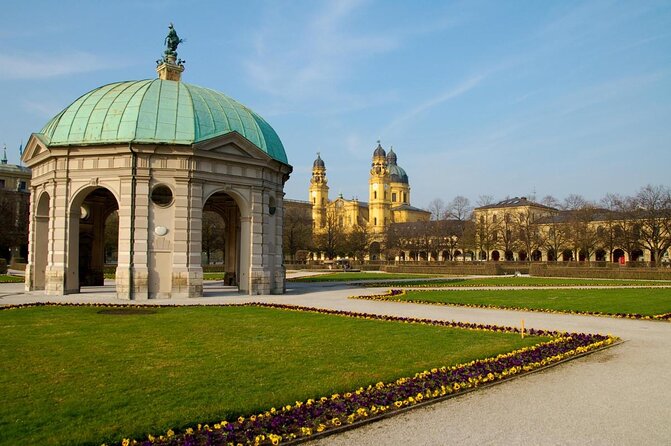
Hofgarten is the fourth stop, with around 20 minutes set aside. It is one of Munich’s major parks, and the tour uses the location to discuss resistance as well as the city’s political past.
This is a welcome change of pace after the heavier architectural stops. The park setting may make the discussion feel less confined, while the subject remains serious. The broader point is that opposition to the regime existed, even though resistance was dangerous and often difficult.
The route also addresses monuments dedicated to resistance and victims of the war. This is where the tour’s purpose becomes broader than a study of Nazi leaders. You are encouraged to consider the choices made by people who opposed the regime, the risks they faced, and the ways later generations chose to remember them.
Allow time for questions here if resistance is a subject you want to explore. The tour has a maximum of 35 people, so the amount of personal discussion may depend on the group and the guide. The format is best for a shared overview rather than a private seminar.
Odeonsplatz and the failed coup attempt
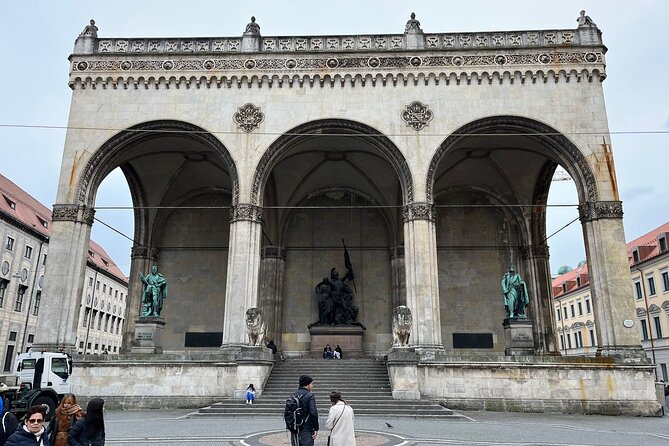
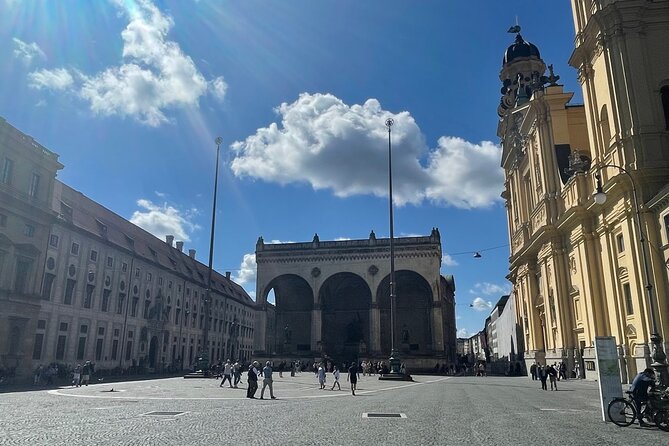
Odeonsplatz is next, with about 15 minutes at one of Munich’s most important squares. This stop connects the city’s public ceremonial spaces with Hitler’s attempted coup.
The Beer Hall Putsch was an early attempt to seize power in Bavaria. It failed, but it became part of the Nazi movement’s later political mythology. Seeing the square in person helps you understand why public space mattered. A square is not merely an open area. It can be used for rallies, confrontations, ceremony, and displays of authority.
This is also a place where the guide’s explanation matters more than the view. Odeonsplatz looks like a normal grand Munich square unless someone points out the political events that took place there and explains how the regime later remembered them.
The 15-minute stop should be enough to establish the main facts, but not enough for a full account of the coup’s causes and aftermath. If this episode interests you most, note the names and dates given by the guide and continue your research afterward.
Königsplatz and the Nazi city plan
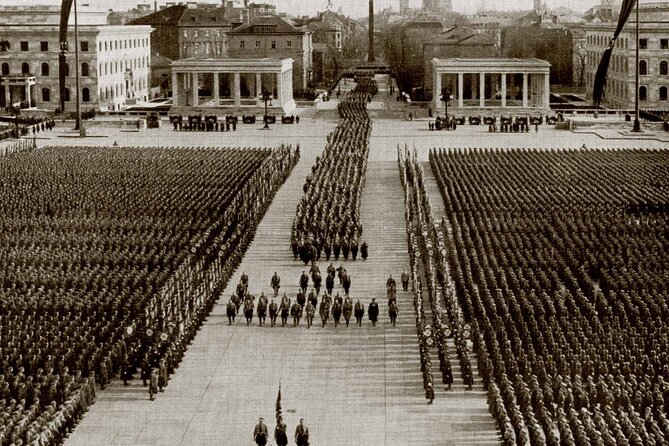
The tour ends at Königsplatz, near Königsplatz 1, after about 15 minutes at the square. This was one of the main parts of Munich’s city plan under the Third Reich and provides a strong final stop.
The square’s scale is the point. Here, you can better grasp how architecture and urban planning were used to express state power. The Nazi government did not just occupy existing institutions. It sought to reshape parts of Munich into a setting for marches, ceremonies, party events, and political theater.
Ending here also gives the walk a clear visual conclusion. Earlier stops show individual buildings and episodes. Königsplatz brings those ideas together in a larger civic setting.
The tour does not include admission to a museum at the end, so you should not expect an indoor exhibition or an extended visit to collections. If you want more detail, this is a good place to continue independently with a museum or memorial visit. The single Spanish-language review supplied for this experience made the same practical point in essence: the subject is so broad that the walk works best as an introduction, followed by museums and further visits.
What you get for $20.16
At $20.16 per person, the price is reasonable for a two-hour guided walk in central Munich. Your fee covers the expert guide and the planned stops. It does not cover lunch, and no separate meal or major museum admission is promised.
The value depends on how much context you want. You can walk through Marienplatz, Hofbräuhaus, Hofgarten, Odeonsplatz, and Königsplatz on your own for free. What you cannot easily reproduce is the continuous explanation linking those places to party organization, propaganda, resistance, victims, and the Third Reich’s redesign of Munich.
I would consider this a good purchase for a first visit to the subject. You pay less than many longer city tours, while getting a focused route through six historically important locations. The limit is depth. Two hours cannot replace a museum, a book, or a specialist lecture.
The walk is booked, on average, 35 days ahead, which suggests that you should not assume a last-minute place during a busy visit. The maximum group size is 35, so you may still be walking with a fairly large group. That is worth considering if you prefer quiet, highly personal guiding.
Timing, walking, and who will enjoy it
The tour begins at 3 p.m. and lasts about two hours. It starts in Marienplatz and finishes at Königsplatz, so you should be ready for a point-to-point walk rather than a return to the starting square.
The experience is near public transportation, and most people can participate. The supplied details do not give an exact walking distance, accessibility information, or a weather plan, so ask the provider if those points matter to you.
I would recommend it to:
- First-time visitors who want a clear introduction to Munich’s Nazi past
- History-minded visitors who prefer places and streets to a classroom lecture
- People planning to visit museums and memorials after the walk
- Those who want an English-language tour with a fixed two-hour schedule
I would be more cautious if you want a very small group, a private guide, or a detailed academic treatment of every event. With six stops and a maximum of 35 people, the experience favors pace and structure over long conversations.
How to get more from the guide
Go in with two or three questions ready. The subject includes Hitler’s early political work, the Nazi Party’s Munich base, the coup attempt, cultural propaganda, Kristallnacht, resistance, and war victims. You cannot cover all of those equally in 120 minutes.
Ask the guide to clarify which sites are original, which have been altered, and which are memorial spaces. That question can help you separate physical evidence from later interpretation.
I would also pay attention to transitions between stops. The value of this route is not any single square or building. It is the connection between them. Munich’s Nazi past becomes easier to understand when you see how meeting places, cultural institutions, parks, ceremonial squares, and memorials fit into one walk.
The 4.4 rating from 19 ratings suggests a generally strong response, though the sample is small. The available written response gives the experience a 4 out of 5 and praises the guide and the route as a very good introduction, while also stressing that the topic deserves museums and additional visits. That is a fair way to judge the tour: useful, focused, and limited by its short format.
Should you book this Munich history walk?
Book it if you want a concise, guided introduction to how Munich became central to the Nazi movement. The route is well chosen, the finish at Königsplatz gives the subject visual weight, and the inclusion of victims and resistance keeps the tour from becoming a simple tour of Nazi power.
Skip it if you already know Munich’s Nazi history in detail or want long indoor visits. You will get the most from the $20.16 price by treating the walk as a foundation, then adding a museum or memorial on your own.
Free cancellation is available up to 24 hours before the 3 p.m. start time. Changes or cancellations made less than 24 hours in advance are not accepted for a refund, and the tour requires a minimum number of participants. If that minimum is not reached, you are offered another date or experience, or a full refund.
FAQ
How long is the Walking Tour on Origins of Nazism in Munich?
The tour lasts approximately two hours.
What time does the tour start?
It starts at 3 p.m. local time.
Where does the tour begin?
The meeting point is the Mariensäule at Marienplatz 22, 80331 München, Germany.
Where does the tour end?
The tour ends at Königsplatz 1, 80333 München, Germany.
What language is the tour conducted in?
This experience is offered in English.
What locations are included?
The route includes the Square of the Victims of National Socialism, Staatliches Hofbräuhaus, Haus der Kunst, Hofgarten, Odeonsplatz, and Königsplatz.
Is lunch included?
No. Lunch is not included.
How many people can join the tour?
The activity has a maximum group size of 35 people.
Can I cancel for a full refund?
Yes. You can cancel at least 24 hours before the experience starts for a full refund. Cancellations made less than 24 hours before the start time are not refunded.
Just added around Munich
- Private tour from Munich to Rothenburg and Harburg★ 5.0 · 3 reviews
- Scenic Adventure Private Day Tour to The Konigssee Salzburg★ 4.5 · 3 reviews
- Private Transfer from Munich to Salzburg, English-speaking driver★ 3.5 · 3 reviews
- Munich: Capture the most Photogenic Spots with a Local★ 5.0 · 3 reviews
- Private Beer Tasting Tour in Munich with Oktoberfest Museum★ 4.3 · 3 reviews
- Munich Photoshoot: A Must-Have Holiday Experience!★ 5.0 · 3 reviews
- Paul’s Private Tour in the Alte Pinakothek Munich★ 5.0 · 3 reviews
- Private Tour to Hallstatt Salt Mine and Skywalk with Lunch★ 5.0 · 3 reviews
Third Reich & WWII Tours, compared.

Birthplace of the Third Reich Guided Walking Tour
Read our review →
Munich World War II Sites Including Dachau Concentration Camp
Read our review →
Munich City Walking Tour, includes Third Reich & Viktualienmarkt
Read our review →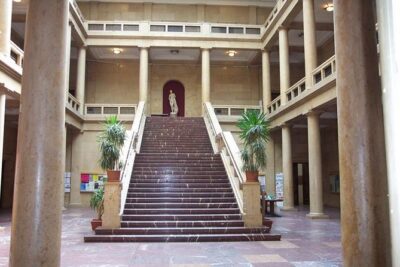
Munich 3-Hour Segway Tour: Nazi Munich & Royal Architecture
Read our review →
Dachau Concentration Camp Memorial Site And Third Reich Day Tour From Munich
Read our review →Browse the lists this tour appears in