
Reviewed · THIRD REICH & WWII TOURS
Munich: Nazi History 2-Hour Small Group Walking Tour
Munich’s Nazi past comes into sharp focus on this walk, which links ordinary city sights with the places where Hitler and the Nazi party built support. You’ll hear how Hitler arrived in Munich as a young man with no clear future, then visit the Hofbräuhaus, Odeonsplatz, and sites tied to the failed Beer Hall Putsch.
I like the small group format, since it gives you room to ask questions and follow the guide’s explanations. I also like the way the tour uses familiar places, including a famous beer hall and grand central squares, to show how political violence grew inside everyday Munich.
The main drawback is the tight two-hour schedule. There is a lot to cover, and the tour may feel brisk if you want a full military, political, and social history of the Third Reich.
In This Review
Key points to know before you book
- Hitler’s Munich story: Follow his arrival in the city in 1913 and his early political rise.
- Hofbräuhaus stop: See the beer hall where the Nazi party met and Hitler gave speeches.
- Beer Hall Putsch history: Learn about the failed 1923 attempt to seize power.
- Alun Evans as guide: Expect an English-speaking guide who brings facts together with personal, thoughtful explanation.
- Compact walking route: The tour begins at Marienplatz and covers central Munich on foot in about two hours.
- Small numbers: The activity is described as limited to 10 people, while another description gives a maximum of 15, so check the group size when booking.
This is not a general city walk with a quick mention of Hitler. The subject is the rise of the Nazi party in Munich, and the route takes you to places where that story unfolded.
You begin at Marienplatz, the city’s central square. From here, the guide sets the scene for Munich after Hitler arrived in 1913. He was 24 years old and had no settled career or obvious path to power. That starting point helps you see the story as a political rise, not simply as a list of wartime events.
I find this opening useful because it places the later crimes and dictatorship within a longer chain of choices, speeches, organizations, and public gatherings. The tour focuses on locations, but the best part is understanding what happened at those locations and why they mattered.
The subject is grim, and the tour does not treat it as entertainment. The supplied details describe a careful presentation of Munich’s darker past, with the guide bringing in facts and stories while handling the material with respect.
You meet in front of the Tourist Information Center on Marienplatz. The guide carries a sign with the local operator’s name, so finding the group should be straightforward.
Marienplatz is a practical meeting point because it sits in central Munich and is easy to recognize. The tour also returns here, giving you a useful place to continue your sightseeing afterward. If you want help walking back with the guide, that option is available on request.
The first section lasts about 30 minutes. Expect a guided walk and an introduction to Munich’s role in the Nazi story. This is where the guide explains Hitler’s arrival in the city and how Munich later became a key center for the Nazi movement.
The square itself is not presented as an isolated memorial site. Its value is that you are standing in the middle of ordinary city life while learning how political movements used public spaces, public attention, and local support.
If you arrive early, give yourself time to locate the meeting point. The activity does not include hotel pickup, and you need to make your own way to Marienplatz.
The Hofbräuhaus is one of the most memorable stops because it connects a familiar Munich symbol with a disturbing political past. The tour includes about 10 minutes of guided explanation here.
According to the tour description, the Nazi party held meetings in the beer hall, and Hitler gave speeches there. That makes the stop more than a quick photo opportunity. You learn how political ideas were presented in a social setting, where speeches, group identity, and public gatherings could reinforce one another.
I like this part of the route because it shows how history can happen in places that still function as everyday attractions. You are not looking at a distant battlefield or a sealed museum room. You are considering the past inside a famous beer hall that remains part of Munich’s public image.
The short timing is also the limitation. Ten minutes is enough for a focused explanation, but not enough for a long discussion of the Nazi party’s early organization, propaganda, and Munich supporters. If this is the stop you most want to explore, ask questions while you are there or make a separate visit later.
Refreshments are not included. The tour passes through a beer hall, but you should not assume there will be time for a drink or meal during the walk.
The route continues to Odeonsplatz, where the guide gives about 15 minutes of explanation. This area includes the Bavarian State Opera and the Residenz building, so you are seeing major Munich landmarks while learning about the political conflict that shaped the city.
Odeonsplatz is especially important because it is linked with the failed Beer Hall Putsch of 1923. The attempt was an early effort by Hitler and his followers to seize power. It failed, but the event became an important part of the Nazi movement’s later story.
This is the kind of stop where the guide’s explanation matters more than the buildings alone. Without context, Odeonsplatz is simply a handsome square near major cultural buildings. With the history explained, you can picture how public space, political marches, confrontation, and state authority came together.
The supplied route details describe the Beer Hall Putsch site as one of the key locations visited. They also list Odeonsplatz as a timed stop. You should expect the guide to connect the two, but if the precise spot matters to you, ask where the explanation will take place.
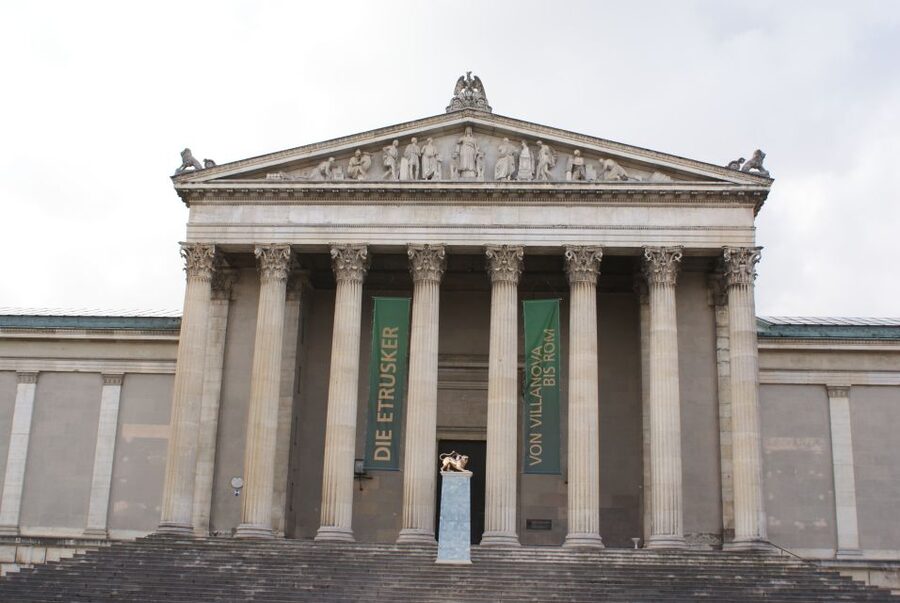
The broader route description includes buildings where the Nazi party and SS were founded, along with Königsplatz, where the Nazis held rallies. These locations help show the movement’s growth from a small political organization into a force that used ceremony, uniforms, architecture, and crowds to project power.
Königsplatz is described as the final historic focus before the route returns to Marienplatz. It is an important contrast with the Hofbräuhaus. At the beer hall, the emphasis is on meetings and speeches. At Königsplatz, the emphasis is on public display and mass political theater.
There is a small point worth checking before you book. The detailed timed itinerary lists Marienplatz, Hofbräuhaus, and Odeonsplatz, while the wider description also names Königsplatz and the SS foundation sites. The experience is clearly intended to cover these central Nazi-era locations, but the exact walking order and amount of time at each may vary.
That is normal for a two-hour city walk, especially when the guide adapts to the group. Still, if Königsplatz is your main reason for booking, confirm that it is included on your departure.
The guide named for this experience is Alun Evans, an English-speaking local guide. The strongest praise centers on his way of presenting the material: clear, respectful, patient, and engaging.
That combination is important on a subject like this. A guide can bury you in dates and names, or reduce the past to a few dramatic anecdotes. The comments provided about Alun point to a middle course, with the right amount of detail and an ability to connect facts with stories.
One particularly useful detail is that the tour works well for people with different levels of interest. A visitor with a serious interest in World War II history can ask informed questions, while someone with less background can still follow the main story.
The small group helps here. The activity is described as limited to 10 participants, while another description gives a maximum of 15. Either size is more manageable than a large city tour, but the exact number matters. A group of four, as happened on one snowy departure, gives you much more opportunity to talk directly with Alun. Even with a full group, you should have a better chance to hear and ask questions than on a crowded walk.
The tour operates in all weather conditions. That matters in Munich, where a two-hour walk can feel very different in bright summer weather, steady rain, or falling snow.
One departure took place during heavy snow and severe cold. The guide still kept the group engaged, but the experience was clearly made more demanding by the conditions. Wear proper outdoor clothing, comfortable shoes, and something suitable for rain or snow if the forecast calls for it.
There is no indoor replacement promised for bad weather. The tour’s subject may be serious enough to hold your attention, but cold feet and wet clothing can still distract you. I would avoid treating this as a casual stroll and prepare for a genuine outdoor walk.
The route is in central Munich, but the provided information does not give a detailed distance or accessibility description. If you have mobility concerns, ask the operator about the walking surface, pace, and exact route before reserving.
Two hours is enough for a focused introduction. You can learn the main stages of Munich’s Nazi story, visit several important locations, and ask questions without giving up an entire day.
It is not enough for every detail. You should not expect a full account of the Nazi regime, the Holocaust, the war, or postwar memory in Munich. The tour concentrates on the party’s beginnings, early meetings, the Beer Hall Putsch, rallies, and the places connected to the movement’s growth.
I see that limit as a useful feature if you plan your day carefully. You can take this walk early in your Munich visit, then decide if you want more time at museums or memorial sites. If you already have a strong background in the subject, the value will come from the locations and from Alun’s explanations rather than from a complete historical course.
The pace may feel quick at the stops. Keep your questions focused, and tell the guide if you want more explanation about one location. A small group makes that kind of adjustment more practical.
At $58 per person, this is not the cheapest way to walk through central Munich. You are paying for a live English-speaking guide, a small group, and a carefully chosen subject rather than for entry to a museum or a meal.
The value depends on what you want. If you are mainly looking for free sightseeing, the price may feel high because much of the route passes through public city spaces. If you want a clear explanation of Munich’s Nazi past without spending hours reading guidebooks or arranging the route yourself, the fee is more reasonable.
The small group is the key part of the value. You are not simply following a guide from one landmark to another. You can listen closely, ask about difficult points, and get a more personal explanation. The strongest comments about the experience emphasize Alun’s respectful manner, clear delivery, patience, and ability to make the history understandable.
The tour also offers free cancellation up to 24 hours before departure and a reserve-now, pay-later option. Those policies make it easier to fit the walk into a changing Munich schedule, though you should still check the available start times before booking.
I would recommend it to you if you want a compact introduction to the Nazi party’s Munich origins and prefer learning in the places where events happened.
It suits:
- First-time Munich visitors who want more than the usual palaces and churches
- People with an interest in World War II or 20th-century European history
- Visitors who prefer a live guide to reading signs and guidebooks
- Couples, families with older children, and small groups who want room for questions
- Anyone looking for a serious two-hour activity in central Munich
I would think twice if you want a broad overview of Munich, extensive museum time, or a leisurely sightseeing walk. The subject is dark, the schedule is compact, and the tour runs outdoors in every kind of weather.
It is also not the right choice if you expect refreshments or hotel pickup. You meet at Marienplatz, and the guide does not provide food or drinks.
Read a little about Hitler’s early years and the Beer Hall Putsch before you arrive. You do not need a long history lesson, but a basic timeline will help you place each stop.
Wear shoes you can walk in for two hours. Check the weather and dress for it, since the activity does not stop operating in rain, snow, or cold.
Arrive at the Tourist Information Center on Marienplatz with enough time to identify the guide’s sign. Since the tour begins and ends in the same central square, you can pair it with other Munich plans before or after the walk.
Use the small group to your advantage. Ask Alun to explain anything that feels unclear, especially at Odeonsplatz and the Beer Hall Putsch site. The tour is short, so a thoughtful question can help you get more from the time than simply listening from the back of the group.
Should you book this tour?
Book it if you want Munich’s Nazi past explained by a live English-speaking guide, with stops at the Hofbräuhaus, Odeonsplatz, the Beer Hall Putsch area, and Nazi rally sites. Alun Evans appears to be especially well suited to the subject, with a calm and engaging way of handling difficult material.
At $58, the tour offers its best value through the small group and the guide’s interpretation, not through admission tickets or included extras. Confirm the expected group size and whether Königsplatz is included in your departure, then dress for the weather.
For a focused two-hour introduction, I would book it. For a full study of Munich under the Nazis, treat it as a starting point and plan additional museum or memorial visits on your own.
More Third Reich and wartime history walks in Munich:
- Munich: Third Reich & WWII Walking Tour
★ 4.6 · 6,181 reviews - Third Reich Walking Tour Munich
★ 4.5 · 4,291 reviews - Munich: Birthplace of the Third Reich Guided Walking Tour
★ 4.6 · 771 reviews
FAQ
Where does the tour begin?
It begins in front of the Tourist Information Center on Marienplatz in central Munich. The guide holds a sign with the local tour operator’s name.
Where does the tour end?
The tour starts and ends at Marienplatz. You can also ask to return there with the guide.
More walking tours in Munich:
- Munich: Old Town & Viktualienmarkt City Walk in German
★ 4.7 · 2,304 reviews - Munich: Night Watchman Walking Tour
★ 4.7 · 2,092 reviews - Munich Ghosts and Spirits Evening Walking Tour
★ 5.0 · 1,900 reviews - Munich Old Town Walking Tour
★ 4.5 · 1,287 reviews
How long does the walking tour last?
The tour lasts two hours.
What language is the tour conducted in?
The tour is conducted in English with a live English-speaking guide.
Who is the guide?
The named guide is Alun Evans, who provides personal tour guiding in Munich.
Is the tour suitable in bad weather?
Yes. The tour operates in all weather conditions, so you should dress for the forecast and wear suitable walking shoes.
How large is the group?
The activity is described as a small group limited to 10 participants. Another description gives a maximum of 15, so check the group size when booking.
More 2-Hour Experiences in Munich
- Discover Munich 2-Hour Small Group Walking Tour
★ 4.6 · 491 reviews - Small-Group 2-Hour Munich and The Third Reich Walking Tour
★ 5.0 · 32 reviews - 2-Hour Segway Discovery Tour Munich
★ 5.0 · 20 reviews - Munich 2-Hour Segway Tour
★ 5.0 · 15 reviews
More Historical Tours in Munich
- Munich: Guided Tour of the historic Town Hall on Marienplatz
★ 4.8 · 63 reviews - Munich Craft Beer & Cultural Tour With Snack
★ 5.0 · 46 reviews - Munich History Tour: Private & Personalized with a Local Guide
★ 4.5 · 33 reviews - Munich and Nazi History Combination Day Tour Small Group
★ 5.0 · 31 reviews
Just added around Munich
- Private Transfer from Munich to Salzburg, English-speaking driver★ 3.5 · 3 reviews
- Private tour from Munich to Rothenburg and Harburg★ 5.0 · 3 reviews
- Scenic Adventure Private Day Tour to The Konigssee Salzburg★ 4.5 · 3 reviews
- Munich: Capture the most Photogenic Spots with a Local★ 5.0 · 3 reviews
- Private Beer Tasting Tour in Munich with Oktoberfest Museum★ 4.3 · 3 reviews
- Munich Photoshoot: A Must-Have Holiday Experience!★ 5.0 · 3 reviews
- Paul’s Private Tour in the Alte Pinakothek Munich★ 5.0 · 3 reviews
- Private Tour to Hallstatt Salt Mine and Skywalk with Lunch★ 5.0 · 3 reviews
Third Reich & WWII Tours, compared.

Birthplace of the Third Reich Guided Walking Tour
Read our review →
Munich World War II Sites Including Dachau Concentration Camp
Read our review →
Munich City Walking Tour, includes Third Reich & Viktualienmarkt
Read our review →
Munich 3-Hour Segway Tour: Nazi Munich & Royal Architecture
Read our review →
Dachau Concentration Camp Memorial Site And Third Reich Day Tour From Munich
Read our review →Browse the lists this tour appears in